
Bharatanatyam vs Odissi: What’s the Difference?
Introduction
Indian classical dance is a celebration of rhythm, devotion, and grace. Among the many styles that have evolved over centuries, Bharatanatyam and Odissi stand out as two of the oldest and most expressive. Both originated as temple dances, yet each developed a unique personality that reflects its region’s spirit — one bold and angular, the other soft and fluid.
Origins and Heritage
Bharatanatyam comes from Tamil Nadu in South India, where it was performed by temple dancers as a form of devotion. Rooted in ancient texts like the Natya Shastra, it is known for precision, rhythm, and powerful storytelling.
Odissi, on the other hand, emerged in Odisha’s temples, inspired by sculptures and carvings seen at the Sun Temple in Konark. Its movements reflect a sense of grace and divine emotion, making it one of the most lyrical Indian dance forms.
Costumes and Expression
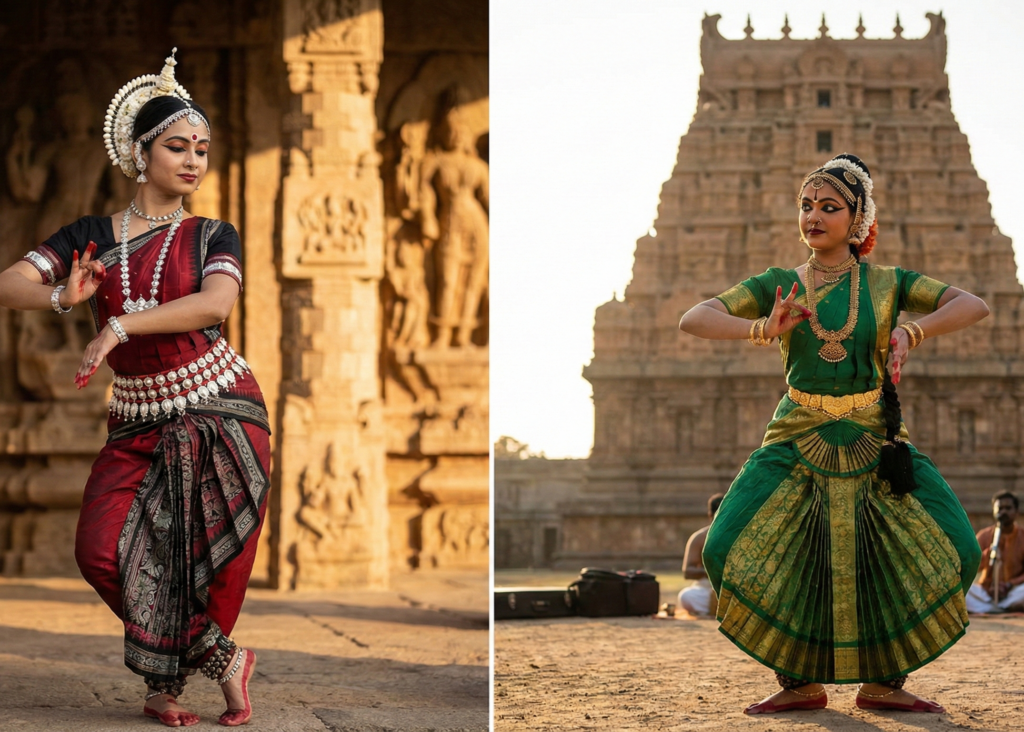
Bharatanatyam dancers wear bright silk costumes with fan-like pleats that accentuate their footwork. Gold temple jewelry and expressive eye makeup highlight their sharp movements.
Odissi dancers, in contrast, adorn handwoven fabrics with silver jewelry and the signature Tahiya headpiece. Their expressions are subtle and emotive, using the torso and eyes to convey divine love and spiritual connection.
Movements and Style
The most noticeable difference between the two lies in posture and motion. Bharatanatyam uses the Araimandi stance, a half-seated position that gives the dancer a grounded and geometric look. Movements are angular, rhythmic, and highly structured.
Odissi features the Tribhangi posture, where the body bends gently at three points — the neck, torso, and knee — creating an elegant S-shaped curve. Its transitions are smooth and flowing, giving the dance a more rounded and graceful feel.
While Bharatanatyam radiates strength and discipline, Odissi embodies softness, devotion, and poetic beauty.
Costumes and Expression
Bharatanatyam dancers wear bright silk costumes with fan-like pleats that accentuate their footwork. Gold temple jewelry and expressive eye makeup highlight their sharp movements.
Odissi dancers, in contrast, adorn handwoven fabrics with silver jewelry and the signature Tahiya headpiece. Their expressions are subtle and emotive, using the torso and eyes to convey divine love and spiritual connection
Music and Rhythm
Bharatanatyam performances are set to Carnatic classical music, emphasizing rhythmic beats and structured compositions.
Odissi music follows its own tradition, blending melody and emotion with lyrics in the Odiya language. Its tunes flow smoothly, mirroring the dancer’s graceful movements.
Essence and Emotion
Both forms share the goal of expressing devotion through art. Bharatanatyam symbolizes fire — strength, energy, and focus — while Odissi represents water — fluidity, emotion, and grace. Together, they embody the perfect balance of discipline and expression, structure and surrender.
Conclusion
Though distinct in form and rhythm, both Bharatanatyam and Odissi lead dancers on the same spiritual journey — one of devotion, storytelling, and self-discovery.
At Chitrakala Arts Singapore, students have the unique opportunity to learn both these beautiful traditions. Each class helps dancers understand not just movement, but the emotion and philosophy behind it.